Guide
Schengen visa photo size and requirements: 35 × 45 mm explained
A Schengen visa photo is 35 × 45 mm (1.38 × 1.77 in) with a 32–36 mm face on a white or light background. Every rule, plus how to get one in the U.S.
- Written by
- idphoto.us Editorial Team
- Last updated
- Reading time
- 9 min read
- Photo size (1.38 × 1.77 in)
- 35 × 45 mm
- Face height, chin to crown
- 32–36 mm
- Or a plain light background
- White
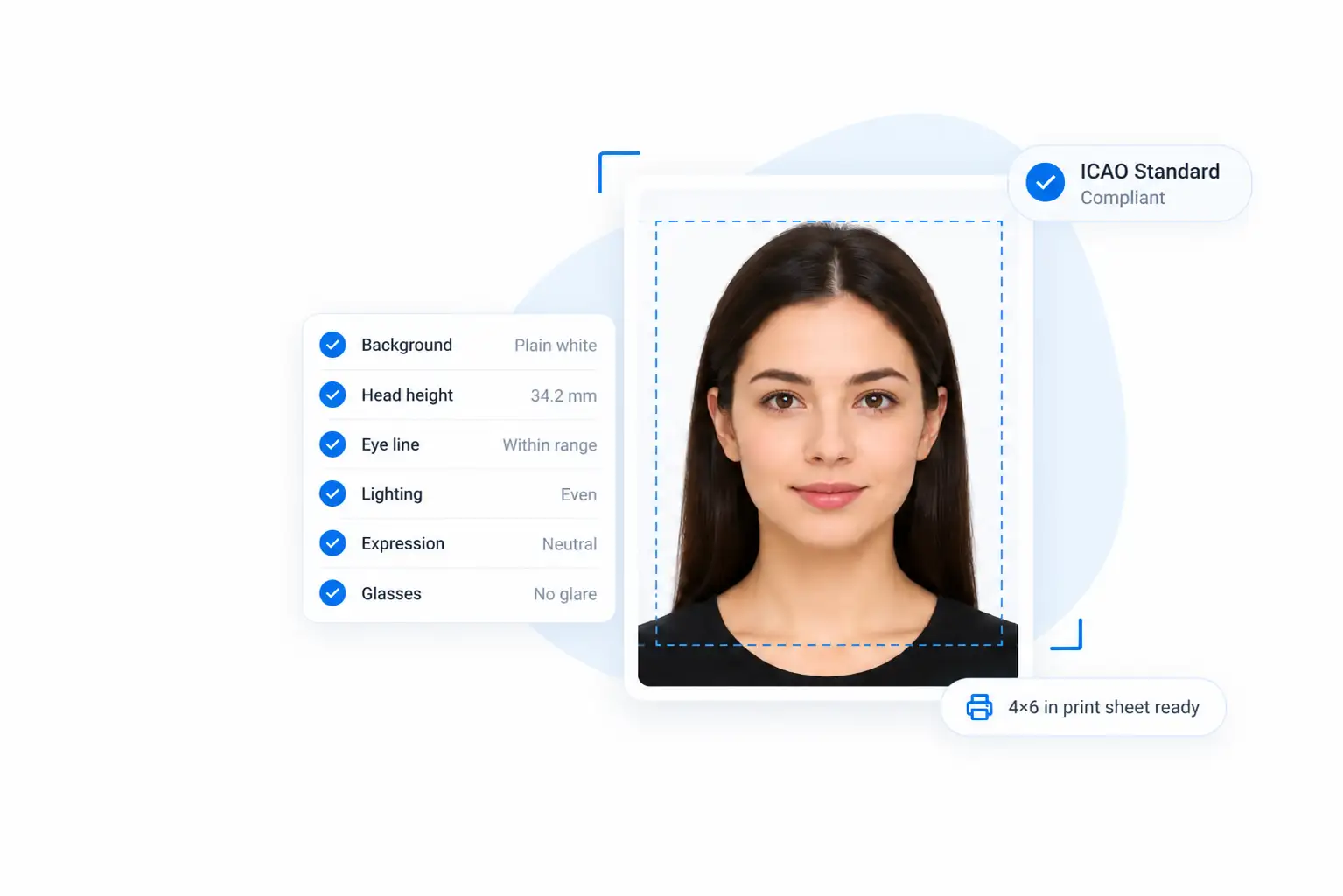
Photo tool
The Schengen visa photo size is 35 × 45 mm (3.5 × 4.5 cm, or about 1.38 × 1.77 inches). Your face should measure 32–36 mm from chin to crown, which fills about 70–80% of the photo. Use a plain white or light background, keep a neutral expression, and make sure the photo is in color and no more than 6 months old.
That's the short answer. The rest of this guide covers every requirement in detail, the small differences between consulates, and the most common mistake U.S.-based applicants make: using a 2 × 2 inch American passport photo.
Schengen visa photo size and dimensions
All 29 Schengen countries use the same short-stay visa application, and the EU Visa Code requires a photo that meets international biometric standards (ICAO Document 9303). In practice, every consulate we checked asks for the same format.
| Specification | Requirement |
|---|---|
| Photo size | 35 × 45 mm (3.5 × 4.5 cm) |
| Size in inches | About 1.38 × 1.77 in |
| Orientation | Portrait (taller than wide) |
| Face height | 32–36 mm, chin to crown |
| Face share of photo | About 70–80% |
| Background | Plain white or light, one color |
| Color | Full color, no black-and-white |
| Photo age | Recent, usually within 6 months |
Schengen visa photo size in inches and cm
In centimeters, the photo is 3.5 cm wide by 4.5 cm tall. In inches, that's roughly 1.38 × 1.77 inches. Because U.S. photo services work in inches, many default to 2 × 2. Always ask for "35 by 45 millimeters" or "European visa size" by name.
Schengen visa photo size in pixels
Consulates don't set a pixel size for printed photos, but the resolution decides how sharp the print looks. To print a 35 × 45 mm photo:
- At 300 dpi, use at least 413 × 531 pixels.
- At 600 dpi, use 827 × 1063 pixels for an extra-sharp print.
Our passport photo editor exports Schengen photos at 630 × 810 pixels, which keeps the 7:9 ratio and prints cleanly at 35 × 45 mm.
Face height and head position
German consulates spell out the most precise rules: the face must measure 32–36 mm and sit centered in the frame. Note that German missions measure from the chin to the hairline, while most ICAO-based guides measure from chin to the top of the head. If your face lands in the middle of that range, you're safe either way.
- Center your face horizontally, with your nose on the photo's center line.
- Look straight at the camera. Don't tilt or turn your head.
- Leave a small gap of background above your head.
- Keep your eyes level, open, and clearly visible.
Most rejected home photos fail here. If you stand too close, your face ends up too big; too far away, and it's too small.
Schengen visa photo requirements
Beyond size, consulates check your appearance, the background, and the photo's quality. These rules come from the German, Dutch, Italian, Spanish, and Czech consular sources listed at the end of this guide.
Background color
Use a plain, single-color background with no patterns, objects, or shadows.
- White works for every consulate. Italy and Spain specifically ask for a white background.
- Light gray or another light shade is accepted by the Netherlands ("white or light-colored") and Germany ("one color and bright").
If you're unsure which consulate will handle your application, choose white.
Expression and pose
Keep a neutral expression with your mouth closed. Don't smile. German missions put it plainly: "Do not smile." Face the camera directly with both eyes open, and keep hair away from your eyes.
Glasses
Most consulates allow clear prescription glasses, with conditions:
- No tinted lenses or sunglasses.
- No glare or reflections on the lenses.
- The frames must not cover your eyes.
Because glare is hard to avoid, the easiest fix is to take your glasses off. The Czech foreign ministry makes one exception for sunglasses: blind applicants may wear them.
Head coverings
Remove hats and caps. You can wear a head covering for religious or medical reasons, as long as your full face stays visible from the bottom of your chin to your forehead. Spain's consulate says garments must not conceal "the oval of the face."
Clothing and accessories
Wear everyday clothing, not a uniform. Avoid clothes that match your background, because a white shirt against a white wall can make your outline hard to read. Remove headphones and anything that hides part of your face.
Lighting and image quality
Light your face evenly, with no shadows on your face or behind you, no glare, and no red-eye. The photo must be sharp and in color. Don't use filters, beauty modes, or apps that reshape your face. Cropping and resizing are fine; changing how you look isn't.
Photo age
Most consulates want a photo taken within the last 6 months that shows how you look today. The Netherlands states this limit directly, and Germany and Italy ask for a "recent" photo. If you've changed your hairstyle, grown a beard, or lost or gained noticeable weight, take a new one.
Schengen visa photo format, paper, and printing
Most Schengen applications still use a printed photo that you glue or attach to the application form.
- Print on photo-quality paper, matte or glossy.
- Make sure the photo has no creases, stains, or marks.
- Don't submit scans or photocopies. Italy's Los Angeles consulate rejects them outright.
- Print at actual size with scaling turned off, so the photo stays exactly 35 × 45 mm.
A cheap way to print is to place several 35 × 45 mm photos on a single 4 × 6 inch sheet and order it as a standard photo print. Our print layout tool builds that sheet for you.
Digital and biometric photos
The Visa Code lets consulates scan your printed photo or take a new one at your appointment. Some application centers do the latter. The Netherlands, for example, tells applicants who apply through an external service provider that they don't need to bring a photo because one is taken at the appointment. Your fingerprints are collected in person either way.
If your consulate's online system asks you to upload a photo, follow its file instructions exactly. Upload rules differ by country and change more often than print rules.
Do you need a Schengen visa photo?
Many readers of this guide live in the U.S., so this question comes first.
- U.S. citizens don't need a Schengen visa for trips of up to 90 days in any 180-day period, as long as they don't work. No visa means no visa photo.
- U.S. residents with another passport (green card holders, H-1B and F-1 visa holders, and others) often do need one. They apply at the consulate of their main destination, usually through an application center such as BLS International or VFS Global.
- Long-stay national visas (type D) for work, study, or family reunion also require a biometric photo, even for some U.S. citizens.
The EU's planned ETIAS travel authorization for visa-free visitors is a separate online form and isn't a visa.
Schengen visa photo vs. U.S. passport photo
This is the most common mistake U.S.-based applicants make.
| Schengen visa photo | U.S. passport photo | |
|---|---|---|
| Size | 35 × 45 mm (1.38 × 1.77 in) | 2 × 2 in (51 × 51 mm) |
| Shape | Rectangle, portrait | Square |
| Face height | 32–36 mm | 25–35 mm (1 to 1⅜ in) |
| Smile | Not allowed | Natural smile allowed |
| Glasses | Clear lenses usually allowed | Not allowed |
A 2 × 2 inch photo can't simply be trimmed to fit. Cutting it down usually leaves your face too small for the frame. Start from the original image and crop it to the Schengen format instead.
Where to get a Schengen visa photo in the U.S.
You have three practical options.
Photo studios and drugstores
Pharmacies, shipping stores, and photo studios across the U.S. take passport photos. Not all of them offer international sizes, so call ahead and ask for 35 × 45 mm, European visa size. Check the printed photo with a ruler before you leave.
At the consulate or application center
Some locations offer photos on site. The German consulate in Los Angeles, for example, has a photo booth in its consular waiting room. Others capture your photo during the biometric appointment. Check your appointment confirmation, and don't count on this unless your center confirms it.
Online, from a photo you take at home
You can make a Schengen visa photo online for free from a picture taken on your phone:
- Stand about 2 feet in front of a plain white wall, facing a window for soft light.
- Have someone take the photo from about 4 feet away, at your eye level.
- Upload it to our passport photo editor and choose Schengen visa. It crops the photo to 35 × 45 mm and checks your face size and background.
- Run the result through our photo checker if you want a second look.
- Print it on a 4 × 6 inch sheet at any photo counter.
Our tools catch common problems, but they aren't an official checker. The consulate makes the final decision on your photo.
Schengen visa photo checklist
Before you submit, confirm each point:
- Size is exactly 35 × 45 mm (1.38 × 1.77 in).
- Face measures 32–36 mm, centered and facing forward.
- Background is plain white or light, with no shadows.
- Expression is neutral, with your mouth closed and eyes open.
- Glasses, if worn, have clear lenses with no glare.
- Photo is in color, sharp, and no more than 6 months old.
- Print is on photo paper, undamaged, and not a scan.
- You have the number of photos your consulate's checklist asks for.
Requirements can change, and individual consulates sometimes add their own rules. Always compare your photo against the current checklist from the consulate or application center that handles your appointment.
Schengen visa photo FAQ
What is the Schengen visa photo size in inches?
35 × 45 mm is about 1.38 inches wide by 1.77 inches tall. U.S. stores and photo apps often default to 2 × 2 inches, so ask for the metric size by name.
Can I use my 2 × 2 inch U.S. passport photo for a Schengen visa?
No. A 2 × 2 inch photo is square and larger than the 35 × 45 mm format, and trimming it down usually leaves the face the wrong size. Take or crop a new photo at 35 × 45 mm.
What background color does a Schengen visa photo need?
Plain white is the safest choice because every consulate accepts it. Some, such as the Netherlands and Germany, also accept a plain light background like light gray. Avoid patterns, shadows, and dark or colored walls.
Can I smile in a Schengen visa photo?
No. Keep a neutral expression with your mouth closed. German missions, for example, state plainly: do not smile.
Can I wear glasses in a Schengen visa photo?
Usually yes, if the lenses are clear, there's no glare, and the frames don't cover your eyes. Tinted lenses and sunglasses aren't allowed. Removing your glasses avoids the problem entirely.
How many photos do I need for a Schengen visa?
It depends on the consulate. Germany asks for one, and other consulates may ask for one or two. Check the checklist from your consulate or application center, and bring a spare in case one gets damaged.
Do U.S. citizens need a Schengen visa photo?
Not for short trips. U.S. passport holders can visit the Schengen area visa-free for up to 90 days in any 180-day period, as long as they don't work. You need a visa photo if you hold another passport that requires a Schengen visa, or if you're applying for a long-stay national visa.
Can I take a Schengen visa photo at home?
Yes. Stand in front of a plain white wall in soft, even light and have someone take the photo from about 4 feet away at eye level. Then crop it to 35 × 45 mm with the right face height using our passport photo editor.
Is a Schengen visa photo the same as an EU passport photo?
The size is usually the same, since most EU countries use 35 × 45 mm for passports too. Each country sets its own passport rules, though, so follow the visa instructions from your consulate rather than an EU passport guide.
Sources
Official references this page was checked against.
- Regulation (EC) No 810/2009 establishing a Community Code on Visas (Visa Code), consolidated text — EUR-Lex, European Union
- Short-stay Schengen visas for 90 days and less — German Missions in the United States, Federal Foreign Office
- Visa Application Procedure in Los Angeles — Consulate General of Germany in Los Angeles
- Biometric suitable photos — Consulate General of Germany in Hong Kong, Federal Foreign Office
- Checklist: Applying for a Schengen visa for tourism — Netherlands Worldwide, Government of the Netherlands
- Schengen Visa for Tourism — Consulate General of Italy in Los Angeles
- Schengen visas — Consulate General of Spain in Los Angeles
- Photo requirements for visa applications — Ministry of Foreign Affairs of the Czech Republic
Was this page helpful?
Related pages
- tool
Passport photo editor
Crop, size and check a passport photo for the U.S. and 60+ other countries.
- checker
Test Passport Photo Free: Check It Before You Submit
Test a passport photo against the official rules before you submit it.
- tool
Print Passport Photos Online, at Home or at a Photo Lab
4 × 6 layouts, paper and printer settings for 2 × 2 prints.
- tool
Convert Any Photo to Passport Size: Crop, Resize and Fix the Background
Turn a photo you already have into passport size.